Kling O3: Character Consistency and Voice Binding Across Scenes
O3 is the variant you reach for when the same character has to appear across multiple renders. Reference inputs, voice binding, and scene replace are the differences.
O3 is not a faster v3 Pro. It is a different model inside the Kling 3.0 family with three capabilities that vanilla v3 Pro does not have: character reference binding, voice binding, and scene editing. If you are shipping a single one-off clip, you do not need O3 and you are paying extra for features you will not use. If you are building a 12-part episode series with the same protagonist, O3 is the only variant in the lineup that makes that tractable.
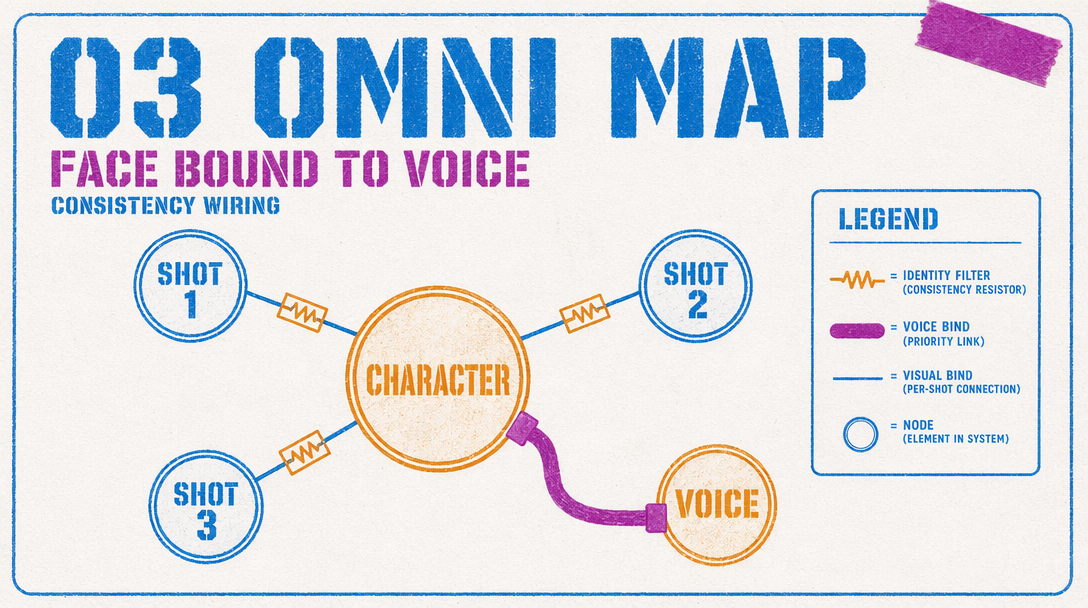
What O3 actually adds
Three things that v3 Standard and v3 Pro do not do.
Reference to video. You pass one or more reference images (face, outfit, environment) and O3 binds those visual traits to the output. On v3 Pro you can pass a single image to image-to-video but the model does not preserve identity across multiple separate renders. On O3 the reference is a persistent anchor you reuse across calls with the same reference ID.
Voice binding. You bind a voice profile to a character reference. Every clip you render with that reference carries the same voice tone, accent, pitch range, and speaker timing. This is the feature that makes episodic content possible. Without it, the speaker drifts between episodes.
Scene editing. You pass an existing video and tell O3 to replace the background, swap the lighting, or change the environment while preserving the subject and motion. v3 does not do this at all. You would have had to rotoscope in post on 2.6.
When to use O3 over v3 Pro
The honest heuristic: if the same character (or product, or location) has to appear in more than two renders, use O3. If it appears once, v3 Pro is cheaper and the Elo 1247 ceiling is already strong.
Use cases where O3 earns its place:
- Episodic series with a recurring protagonist
- Product videos where the same SKU appears in 10 angles
- Brand campaigns with a spokesperson across 20 clips
- Localized dubs where the character is the same but the language changes
- Anything where the client will reject "the face looks slightly different in shot 4"
The O3 call shape
O3 Standard and O3 Pro both accept a references array with image URLs and optional voice profile IDs. You generate voice profiles in a prior call and reuse the returned ID. Character references work the same way.
1import { fal } from "@fal-ai/client";23fal.config({ credentials: process.env.FAL_KEY });45const result = await fal.subscribe("fal-ai/kling-video/v3/pro/reference-to-video", {6 input: {7 prompt: "Mira walks into the warehouse and inspects a pallet of boxes, says, shipment came in early",8 references: [9 { type: "character", image_url: "https://storage.googleapis.com/falserverless/example_inputs/mira_ref_01.jpg", id: "mira" },10 { type: "voice", profile_id: "voice_mira_warm_mid", bind_to: "mira" }11 ],12 duration: 8,13 aspect_ratio: "16:9",14 cfg_scale: 0.5,15 audio_enabled: true,16 audio_language: "en",17 negative_prompt: "blur, distort, and low quality"18 },19 logs: true20});2122console.log(result.data.video.url);
Scene edit flow
Scene replace is a sub-mode. You pass an existing video URL and a new scene prompt. O3 preserves the subject motion and voice, swaps everything else. Typical use: client approved the talent on a green screen render. You want that talent in three environments (office, warehouse, factory) without re-shooting. Three scene edit calls, one input video, three outputs.
Cost vs v3 Pro
O3 Pro carries a surcharge over v3 Pro for reference binding and scene editing. Expect roughly 15 to 25 percent premium per second depending on how many references you pass. If you are not using references, there is no reason to call O3. Use v3 Pro and save the delta.
Limits that still bite
Character consistency is strong but not absolute. Side profiles drift on long clips. If the character turns 180 degrees, back-of-head identity is a guess. Pass two reference angles if you need front and back continuity. Voice binding is accurate on tone and pitch, less so on accent drift past 12 seconds of dialogue. Scene edit handles static swaps cleanly, struggles when the subject physically interacts with the scene.
O3 is the right tool for series work. It is overkill for one-offs. Pick the variant that matches the lifespan of what you ship.